
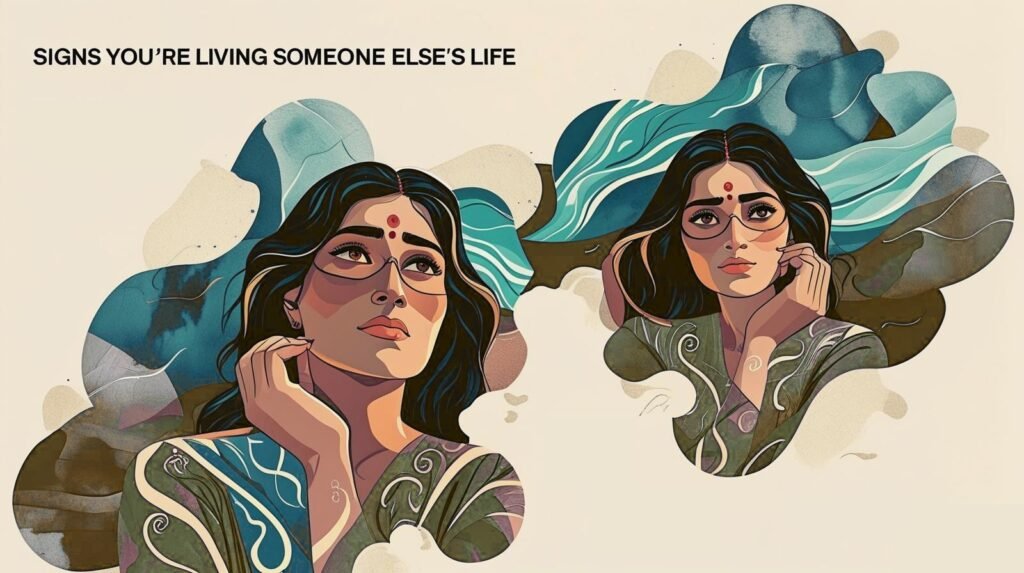
Can I ask you something before we even begin?
Do you feel you are living for Others?
When was the last time you made a decision, a real one, not a compromise — that was entirely yours? Not influenced by what your mother would think. Not shaped by what your partner expects. Not filtered through the version of you that you’ve been performing for so long, you’ve almost forgotten it’s a performance. Living for Others became your first option.
If you had to pause to answer that, this post is for you.
Why do I feel like I am living for Others?
“Why do I feel like I don’t know who I am anymore?“
That question gets typed into Google thousands of times a day. It gets whispered into Instagram DMs between friends who thought they were the only ones feeling it. It shows up in Reddit threads at 2 am, in journals that haven’t been opened in months, in the middle of a perfectly ordinary Tuesday when something feels off — and you can’t explain why.
Here’s what I know after working with women in this exact place: that feeling isn’t confusion. It’s clarity trying to find its voice.
First — What Does It Even Mean to Live for Others?
It doesn’t mean you were forced into anything. It rarely does. Most of the time, it happened gradually, quietly, in all the ways we learn to be “good.”
Good daughters. Good partners. Good employees. Good women.
You said yes when you meant no. You took the “sensible” path because that’s what made everyone else comfortable. You shaped yourself around other people’s expectations so consistently that at some point, you stopped checking in with yourself about what you actually wanted.
“I feel like I’ve lost myself in my relationship / my career / my family”
Psychologists call this self-concept erosion — when the gap between who you truly are (your authentic self) and who you’ve been performing (your social self) becomes so wide that you start to feel hollow. Like you’re watching your life from behind glass.
It’s not a personal failing. It’s what happens when we’re never taught that choosing ourselves is allowed.
Signs You Might Be Living Someone Else’s Life
Some of these will be obvious. Some will hit quietly. Read slowly.
Sign 01
You feel successful on paper — but strangely empty inside
Good job. Stable income. Relationships that look fine. And yet, there’s this persistent feeling that something is missing. Not a crisis — more like a low hum you can’t quite locate.
This is one of the most disorienting experiences a woman can have, because the world keeps telling her she should be grateful. And she is — while simultaneously feeling like she’s slowly disappearing.
What’s happening here: Psychologists describe this as the difference between hedonic wellbeing (feeling good) and eudaimonic wellbeing (feeling meaningful). You can have a perfectly comfortable life and still feel profoundly unfulfilled if it isn’t aligned with your core values and authentic desires.
Sign 02
You constantly overthink decisions — even small ones
What to order. Whether to say something. Whether to apply for that thing. Whether to want the thing in the first place.
“Why do I overthink every little decision? Am I just anxious, or is something else going on?”
When you’ve spent years filtering your choices through other people’s preferences, you lose access to your own instincts. Overthinking is often the mind trying to calculate whose version of right applies here — because you haven’t given your own voice enough room to just… answer.
Sign 03
You start things and don’t finish them — and you don’t fully understand why
The course you enrolled in. The creative project you began with so much energy. The business idea you’ve been carrying for three years. They all start with a spark — and then quietly fizzle.
This isn’t laziness. And it’s not that you’re not capable. Often, it’s because somewhere underneath the excitement, a part of you is asking: Is this really what I want? Or am I just doing what I think I’m supposed to want?
When the desire isn’t authentically yours, the energy doesn’t sustain itself.
Sign 04
You feel more comfortable helping others pursue their dreams than your own
You’ll show up for a friend’s business launch at midnight. You’ll spend hours helping your sister think through her decision. But when it comes to your own dreams? The momentum stalls. The plans stay in notebooks.
What’s happening here: This is a pattern often rooted in conditional self-worth — the belief, usually absorbed early, that your value comes from being useful to others. Investing in yourself feels almost selfish. It isn’t. But that belief runs deep.
Sign 05
You feel under-expressed — like there’s a version of you that never got to speak
You have thoughts you don’t share. Opinions you soften before they leave your mouth. A creative or intellectual side that rarely gets full expression because somewhere along the way you learned it was too much, or not appropriate, or just easier to keep quiet.
“Why do I feel like I can’t be my true self around anyone?”
That quiet version of you — the one waiting just underneath the surface — isn’t gone. She’s just been waiting for permission.
Sign 06
You’re afraid of what choosing yourself would cost you
Not because you don’t want to change. But because you can already picture the disappointed faces. The “I thought you were doing so well.” The fear that if you start being more yourself, you’ll lose the people who only know the version of you that always said yes.
That fear is real. It deserves to be named. And it also isn’t a reason to keep living small.
Sign 07
You watch other women living boldly — and feel a complicated mix of inspiration and grief
She pivoted her career. She started the business. She moved to the city. She said no to the thing everyone expected her to say yes to. And watching her stirs something in you that’s part admiration — and part a quiet ache for the life that feels like it’s passing you by.
That ache? That’s not envy. That’s recognition. It’s your soul pointing at what it wants.
What Women Inside Their Identity Look Like
I want to show you something. Because sometimes the most powerful thing isn’t a framework — it’s a glimpse of what’s actually possible.
These are real patterns I see in women who have done the work of coming back to themselves. Not perfect women. Not women who have it all figured out. Women who simply decided to stop outsourcing their identity.
Priya · 34 · Marketing Manager
For years, Priya took every opportunity that made sense on a CV. Safe choices. Smart choices. She was good at her job and miserable in ways she couldn’t explain at dinner parties. After working on her identity, she realised she had been chasing achievement as a substitute for meaning. She didn’t quit her job. She changed why she was doing it — and started a Sunday creative practice she’d been postponing for six years. That shift changed everything about how she showed up, Monday to Friday.
Simran · 41 · Mother of two, Former teacher
Simran had been “Mum” so completely that she’d genuinely forgotten what she liked doing before children arrived. Not lost, it’s forgotten. She couldn’t even answer the question “What do you enjoy?” without referencing her kids. The work for her wasn’t about reinvention. It was about permission. Permission to have preferences. To take up space. To want things. Quietly, without drama, she came back to herself. And her children got a more whole version of their mother.
Meera · 29 · Recently engaged, quietly terrified
Meera was doing everything “right.” The relationship that her family approved of. The career that made sense. She couldn’t explain why she cried in the car on her lunch breaks. Through identity work, she realised she had been living the life designed for her by everyone who loved her — and none of whom had ever asked her what she actually wanted. She didn’t blow up her life. She learned to bring herself into it.
These women didn’t make dramatic gestures. They didn’t leave everything behind and move to Bali. They did something quieter and harder — they started telling the truth about who they were. And then they built from there.
“Coming back to yourself isn’t about becoming someone new. It’s about finally letting the person you always were take up the space she deserves.”
· · ·
So — How Do You Find Your Way Back?
This is where I want to be careful, because this is usually the part of the internet where someone gives you a 5-step checklist and a free PDF and calls it a transformation.
That’s not what this is.
Finding your way back to yourself is a process. It takes honest reflection. It takes someone in your corner who can see you clearly — often more clearly than you can see yourself right now. It takes being willing to sit with uncomfortable answers instead of reaching for comfortable distractions.
“How do I figure out what I actually want in life? I feel so confused about everything.”
But here’s what I can offer you, right now, as a beginning:
Start noticing the moments you feel most like yourself. Not happy, necessarily. Not productive. Not useful. Most likely yourself. When you’re in a conversation, and you forget to perform. When you’re doing something, time disappears. When you say something, and it lands — and it was genuinely you who said it, not the edited version.
Those moments are data. Start collecting them.
Pay attention to what you’re quietly resentful about. Resentment, as the researcher Brené Brown describes it, is almost always a sign that we’ve crossed our own boundaries — or that we’ve allowed someone else to. It’s not a character flaw. It’s a compass.
Ask yourself, without judgment: If nobody whose opinion I cared about would ever find out — what would I do differently? The answer to that question is worth sitting with for a while.
· · ·
You Don’t Have to Figure This Out Alone
If this resonated — if you read any part of this and thought “that’s me” — then I want you to know something: that recognition is the beginning. Not the end. The beginning.
I work with women who are exactly where you are right now. Aware enough to feel the misalignment. Ready enough to do something about it. And deserving of a space where they can finally stop performing and start becoming.
If you’re curious about what that looks like, I’d love to have a conversation. No pressure. No pitch. Just a real talk about where you are and where you want to be.
Let’s Talk →